Sunday, April 22, 2012

The Third Sunday of Easter [Year B] - April 22, 2012 (Luke 24:36-48)


I am appreciative of the stories we have in the New Testament of Jesus’ appearances after his resurrection. On the one hand, I appreciate them for the good news they give us. These accounts of Jesus with his disciples show us that the crucifixion was not the end of the story. The fact that Jesus appeared to his disciples and others several times shows that Jesus lives, death has been conquered, and the great gulf of sin that separated us from God has finally been bridged.

On the other hand, I find that I’m also appreciative for these stories because they’re so honest about the way those disciples and friends first respond to that news. They show us, for example, that the disciples never  coolly accept what is being presented to them, casually coming to terms with what it all means—“NBD,” as they might text it today. These accounts also never show the disciples and friends of Jesus slamming their hands against their foreheads in a “duh”-like expression. “Of course he’s risen from the dead!  What were we thinking?”

"Christ's appearance on the mountain" Duccio di Buoninsegna (1308-11)
Neither do these accounts show the disciples particularly revved up to tell anyone about it. Granted, the Holy Spirit has not yet been sent to help the believers make sense of it all—we get that story in the book of Acts and, boy, let me tell you, they eventually get pretty revved up—but even here, in the days fresh after it’s happened, you might expect the disciples to show some immediate faith and interest, some compulsion to spread this unbelievable news. But the word “faith” isn’t even mentioned, and the disciples are mostly overcome with terror and confusion. Even in their joy they still struggle to believe. Instead of being some biblical version of a rubber-stamp, “happily-ever-after” ending, these resurrection appearances do a good job of showing that the disciples have been presented with something that they can’t quite get their head around, that the whole concept of Jesus’ miraculous and mysterious rising from the dead was pretty hard to grasp...not to mention getting revved up about so as to serve as witnesses.

There is great irony in this because Jesus spends much of his time during these appearances going about trying to show that he is, in fact, something to be grasped. And I’m not talking about grasping just the concept or idea of the resurrection or the theology of it all or grasping the underlying Scripture that tells its story…but his actual body, himself.  It can be grasped. “Touch me and see,” he says to his followers, “for a ghost does not have flesh and bones as you see that I have  By the way…Do you have anything to eat?” The risen Lord spends a good bit of his time after the resurrection finding his friends, searching out community, doing what he can to convince his followers that his body is real and that he is not a supernatural spirit. So Jesus offers, then, what a real human can offer: flesh and bones. Skin, supposedly with wounds.  And an appetite.

Interestingly, this story from Luke does not mention Jesus’ wounds directly. We often assume he shows wounds here because he does so in other gospel accounts and we know that the crucifixion would have left marks in his hands and feet, however here the emphasis is on the hands and feet themselves. In the ancient Middle East, men typically wore (and still wear) a tunic that covered the entire body, leaving only the hands and feet exposed. Here he offers them as proof that he has bones and skin, that he literally takes up space in this universe and is not just an image.

The fact that Jesus can be physically grasped may eventually help the disciples understand that what they are seeing is real. He establishes his reality—his graspability—so he can get to the point of his resurrection: that repentance and forgiveness of sins may be proclaimed in his name. The entire gospel story has been working toward this point. Way at the beginning John the Baptist came preaching repentance and the forgiveness of sins. Jesus’ whole ministry was based on seeking out the lost and least, ensuring them—and others, at the same time—that God’s forgiveness was offered even unto them, despite what the religious leaders were saying. Now that death, the last barrier separating God from creation and creation from itself, has been defeated, full forgiveness in God’s name may be proclaimed and made real to all nations.  
In fact, if this is what the community of Jesus’ followers is to be about—to offer forgiveness and embody it with each other—it must be a real community, a physical presence. In being emphatic about his own physical presence, Jesus is, in a way, conveying to them the importance of their own lives, their own bodies, their own flesh and blood, in the ministry of his gospel. That is to say, as witnesses, they will also need to be a community that can be grasped, a group of people that actually takes up space in the universe. They will not just have thoughts about God and God’s forgiveness and the Bible and all that jazz, or just speak words about repentance or theories about binding up the broken-hearted. They will do it. They will practice it. They will exert real, physical energy to attempt it. These followers of the risen Lord will allow themselves to be touched and even wounded in order for it to be made real.

I recently ran across an incredibly uplifting obituary (imagine that: an uplifting obituary!) in one of my favorite magazines for a British woman named Lyn Lusi. I had never heard of her before until her death, but reading about her life made me wonder why I never had. Lyn Lusi was a Christian missionary’s wife who worked almost her whole life in the most remote and dangerous corners of Congo, the country formerly known as Zaire. Her husband was a doctor and a hospital builder; she was his main administrator. There, in one of the harshest and darkest places of the universe, Lyn and her husband took up space, working through the years to train thirty doctors and tending countless sick and injured. When Lyn Lusi discovered that many women in her area had been brutally sexually assaulted by militia men and then disowned by their families, she responded by offering them all the love and compassion that she possibly could. Together, she and her husband founded an organization called HEAL Africa, the letters in HEAL standing for Health, Education, Action, and Love.  She died last month from cancer at the age of 62, but not before she and her husband had helped treat, often with surgery, over 5000 of these cases.

Lyn and Jo, her husband
One of the most remarkable aspects of their ministry of healing was her recruitment of local “mamas,” women from surrounding villages who would stand ready to welcome the injured, forsaken, often filthy women with open arms as they got off the buses in front of the hospital. It was a ministry of grasping and being grasped: the life of resurrection faith that takes up space in the universe, one that does not just sit around dreaming about things like forgiveness and a world without pain, but puts its flesh and blood on the line to embody it.

The world will dearly miss Lyn Lusi, but she is far from the only example of this grasping, graspable life of faith. I caught glimpses of it yesterday as volunteers here stretched and sweated as they set up the fellowship hall for our CARITAS guests, hooking poles together and unloading sleeping mattresses on a sunny Saturday. We see examples of it all the time here as people lug food donations into the HHOPE pantry and then sort it, weigh it, bag it, and lovingly hand it to real people in our community who need it. Then there’s Cecil McFarland, chaplain to state prisons, physically going to the incarcerated to share the news of forgiveness.

This graspable faith is also put into motion by the tireless volunteers who do their best to make sure that this particular place of bricks and mortar is locked and secured on a regular basis, outfitted with the best and cleanest facilities for our ministries, grass and altarware shined up.

And this same faith is embodied by those who come to sit their real, flesh-and-blood hineys down in pews at some point during the week to hear about this Jesus who has been risen from the dead. These and more are instances of people who are living in their own bones the reality of a world set to rights by the death and resurrection of Jesus Christ, people who are working out what it means to offer forgiveness of sins, repentance to a life of serving others in Jesus’ name.

I often get wind of anxiety, especially in our country, about the future of the church and whether it will be relevant amidst the new challenges of technology and science. I hear of anxiety about how people of faith can or should adapt to changing cultural mores and attitudes about everything from sexuality to politics to economics. There is a sense that we’re losing ground, or that we’re losing influence. While the challenges that face us are real, sometimes I think the anxiety is much ado about nothing. What place will the church have? Will we thrive? Will we be—dare I say it?—relevant?

Friends, the church will always have a place in this world because it has been given to proclaim and embody the forgiveness and repentance in Jesus’ name, because it is the community dedicated to standing there, offering words of healing and real arms of embrace as the world gets off the bus, looking for hope, looking for a new start. The church will always be relevant not because it’s just acquainted with the concept of new life, but because it allows itself to be present, grasped, touched—and, yes, wounded—as it proclaims the forgiveness of sins, as it offers repentance, a life in the direction of God.

And to do so, we must not forget our appetite—our appetite for his meal. We’re going to need some nourishment. Let us be strengthened by the promise that Jesus is somehow still with us, God’s little children, breaking his body and pouring out his blood to bind up the brokenhearted and restore us to God’s heart. And even when we cannot explain it, even when this meal, this moment, this mystery cannot be grasped by our minds, let us at least grasp it with our hands. May the joy of this news—He is risen!—then grasp us and empower us, once again, to take up space here in this universe, to proclaim his forgiveness and serve as witnesses to the life he offers.  Relevant…now and forever.


Thanks be to God!


The Reverend Phillip W. Martin, Jr.


Sunday, April 15, 2012

The Second Sunday of Easter [Year B] - April 15, 2012 (John 20:19-31)

Norman doorway at Aberdoran, Wales

Christ is risen…and a community is formed. Such a concept is so commonplace to us now, so second-nature. As a matter of fact, it probably doesn’t even register with us as essential because we’re so accustomed to practicing our faith together, in a group, but it still needs to be said. Christ is risen…and a community is formed. A community is formed because that is what we humans do when calamity strikes, when momentous events occur, when we’re hit with news that knocks us down.

The most recent example I can think of to explain this was the Louisa County earthquake last August. Like many of you, I was alone when it struck. Sitting in the office here at church, I first thought someone was on the roof working on the air conditioning again. But as the rumbling wore on, getting worse, it dawned on me what might be really happening. For a split second I thought, “Am I supposed to get in a doorway or in a bathtub? One of them applies in this situation…the other applies in a tornado.” But then I couldn’t resist: I rushed to find other people. It was a natural reaction, an instinctive consequence to tragedy: go find others. Hanne, our administrative assistant, was out in the main office. Together, we looked into the Commons for others. Two women we didn’t even know who had just left a meeting in the church had also felt the earth move and began asking us questions. Within moments, we were all trying to call family. Unfortunately, but for obvious reasons, the networks at the time were either down or busy. And then, of course…the Facebook and Twitter posts began. All afternoon people were checking in with one another—whether on-line or in person, or both—to verify stories, to soothe fears, to clarify facts.

This is precisely the scenario with the disciples after Jesus’ resurrection. They gather. No stopping to stand in the doorway or get in the bathtub first. The New Testament is clear that the news about Jesus’ resurrection from the dead immediately brings about community. In John’s gospel this community of disciples, which was in all probability not limited to the main Twelve, meets behind locked doors. A community is formed for sure, but it is a community based in doubt and fright. They gather to verify the story, to soothe fears, and to clarify facts. Can’t you just hear their questions as they consult with one another?

“Did this really just happen?”
“What’s going on?”
 “Hey, are you OK?”
“What, in God’s name, do we do now?”

I imagine you can hear those questions because they are essentially the same ones we are still, in some ways, asking. Maybe I should speak for myself, but I have a hunch that many of you are here on Sunday because of the same mix of doubt, faith, and astonishment. Each of us feels somehow compelled to gather…almost as if someone might be gathering us. And we come and hear the story of that unique early morning after the Sabbath when the women went to anoint his body with spices and the body wasn’t there. And although almost 2000 years separate us from that first earthshattering morning, and although by now we’ve come to understand that Jesus’ resurrection does not constitute a calamity for us, we gather and we hear and we share our stories with one another and, even when we don’t say a word to each other, on some level we still seem to be asking,

“Did this really happen?”
“What’s going on?”
“Hey, are you OK?”
“What, in God’s name, do we do now?”

Ever since that first night in that locked room, it has been apparent that the news of Jesus’ resurrection doesn’t only mean something to individuals. That is to say, Jesus doesn’t rise from the tomb simply so that individual believers can rest in peace that their souls are somehow sealed for heaven, although that is certainly how it has often been interpreted. No, Christian faith is never a completely private affair. It is a community event. The news about Jesus resurrection is something that happens to us; it is something we hear and respond to. And even if, like Thomas, we are not, for whatever reason, immediately drawn to community when we hear the news—even if we are left out because of our doubt or other circumstances, we are still at some point pulled in to verify, fact-check, possibly even poke holes in the theories. The news about Jesus’ resurrection brings us together because that it where we will find solace. That is where we will be able to question each other and sustain each other with hope.

But more than that, this news of Jesus’ death and resurrection forms a community because that is how Jesus is going to continue to work in the world. Jesus does three things in that room with his followers on the night of his resurrection: he grants his peace, he sends them in the same way his Father has sent him, and he breathes on them the Holy Spirit, giving them—as a group—the power to forgive and retain sins. All three things—living in God’s peace, spreading the message about God’s love in Christ, and embodying forgiveness—all but require gathering and living as a community in order to live out and practice. Jesus does not return to say, “Be at peace with yourself and find enlightenment on your own.” He gives them commands that will necessitate community living and gathering. When in our confusion we gather and ask the question, “What, in God’s name, do we do now?” the answer becomes clear: this community’s life and work will be an extension in the world of Jesus’ own life and work. As Jesus is sent by the Father, so are we sent to bear to the world this unconditional love. This is what we do…and we do it in God’s name.

Perhaps most importantly, however, the community that is formed as a result of Jesus’ ground-breaking resurrection helps make room for those who doubt, helps those who linger on the border between faith and disbelief, those who still want to ask those questions, “Did this really happen?” The community of disciples becomes a borderland between the disbelieving world and the true existence of God, a place where God’s Spirit is very alive and active, drawing people in and opening hearts. As it turns out, we do find ourselves standing in a doorframe.

It is a funny thing about this story: Thomas seems to get all the credit for being the doubter, for needing to see with his own eyes that Jesus is risen, when, in fact, all of the disciples are actually shown Jesus’ wounds as proof that it was him. The gospel writer John makes sure to tell us that it isn’t until after Jesus shows them his hands and his side when they rejoice in his presence. And when Thomas finally finds his way that next week to the community of the disciples, Jesus addresses his doubt with love and patience, offering up his body once more for the sake of another.

"The Incredulity of St. Thomas" Rembrandt (1634)
When the church becomes a place where doubters are condemned or shunned, where questions about faith are not welcomed and lovingly dealt with, then the church remains frozen in fear, locking its doors to the very world to which Jesus has sent it. Jesus will still be able to enter and appear, just like he does that first evening, but it will be difficult—if not impossible—for others to find the hope and comfort in the community that his resurrection has brought about. Likewise, that community of fear and suspicion will never be able to practice fully the mission of forgiveness and peace that Jesus’ Spirit has given it. Yes, Jesus is risen and a community is formed…a community that is gathered to hear, time and again, the stories of their faith, ask their questions, and hear the promise of Jesus’ constant presence even when our fear and confusion have locked him out.

Each spring I give the seniors of the youth group a letter I’ve written. It changes a bit from year to year, but the basic message is still the same. It is a letter trying to explain, in my own words, why the Church is important (This year’s group of seniors could have written such a letter to me.  I’ve learned so much from them). We all know that those first years of independence—away from parents and out of the Epiphany bubble—are times of testing, changing, dealing with all kinds of new challenges and excitements. Statistics show that many young adults fall away from the faith entering some period of doubt and less than regular church attendance. I’d like to think I might get one last word in there before they go off, sent like Jesus was sent by the Father into new horizons. The letter is probably too rambling and preachy (like this sermon), but, for what it’s worth, this is one of the paragraphs I’ve included:


“There is another big reason why we become anxious that you may wander away too long from this imperfect but nevertheless gracious community: we don’t want you to forget the stories…the stories of our faith—like how God gave Israel manna to eat in the desert on their way to the Promised Land even though they complained about it, and how God once saved Noah and the animals with the ark. Or the one about Jesus’ feeding the five thousand with five loaves and two fish, and the one about the shepherd who goes after the one lost sheep. The church tells and re-tells itself those stories not simply because they are powerful and fun, but because they help us remember the most important thing of all: through Jesus, God gives true meaning for the entire world and rescues it from sin. Let me tell you, there are times you will feel like that lost sheep (as we all do, from time to time), and you will need to know God has come for you and will carry you back on his shoulders.”


Given this morning’s readings, I should add, And there are times when, when you are wracked by unbelief, hearing these stories will be like reaching your hands into the Risen One’s wounds.  You will need to be with others who are grappling with the same and wonder together at what this all means.  I propose that is one big thing the church is doing every week, doubters and believers and everyone else gathered in the doorway: hearing the story of his resurrection, allowing his words to fall fresh on us once again, and asking ourselves, once again, those same familiar questions:

 “Did this really happen?”
“Are you O.K.?”
“What, in God’s name, do we do now?”


And, because we’re here, and because we’re together, we hear the responses as they resound:

“Peace be with you.”
“This is my body, given for you.”
 “You are sent…just as I have been sent.”
“Do not doubt, but believe.”


Thanks be to God!


The Reverend Phillip W. Martin, Jr.

Sunday, April 1, 2012

Palm Sunday/Sunday of the Passion - "The Cry of the Whole Congregation" - April 1, 2012 (Mark 1:1-11)


As they say, everyone loves a parade. Richmond loves a 10K.

How about a quick show of hands? How many of you participated in some way in the Monument Avenue race yesterday—or any year, for that matter—either running, jogging, walking or cheering folks on? Race officials tell us that just over 40,000 people registered for the event of the year yesterday, which coincided, somewhat appropriately, with the weekend of Palm Sunday this time. Many thousands more stood and cheered on along the route or waited at the finish line to support friends, family members and colleagues, or to enjoy the free-handouts of bananas and water bottles. Rain and chilly weather would not deter them, because, after all, everyone loves a parade.

To a degree, that’s what it felt like, at least to this participant. Maybe I just had Palm Sunday on the brain, maybe I got too caught up in the moment, but as I ran along the tree-lined avenue, the well-manicured lawns of the stately homes on my left and right, my mind drifted to the similarities and stark differences between what we were doing and the procession Jesus made into Jerusalem around 2000 years ago.

I looked hard, but I didn’t see anyone waving palm branches or “leafy branches” yesterday, not even the Jimmy Buffet cover band and fan club that was stationed just before mile marker 1. Instead, people waved things like signs and held out cups with water and Powerade. Some of the signs included messages to those I assumed were fighting cancer or signs made in memory to those they had lost. No one was strewing articles of clothing at our feet, but when I saw the elaborate and well-coordinated costumes that some people wore, I realized clothes did play an important part in the event for many people.

And about all those people! It’s difficult to pin down specific numbers, but historians tell us that during Passover, the population of Jerusalem could swell by an extra hundred thousand or so. In the gospels, it seems even Jesus can’t find a place to stay within the city walls and keeps going out of the city each night and then returning during the day. Jews would come in from all over the place—from as far away as Libya, Crete, Babylonia—to participate in the annual Jewish festival. You couldn’t stir ‘em with a stick yesterday in downtown Richmond, and I know for a fact there were runners from Ethiopia, Kenya, and Morocco because they won the race. To celebrate Passover according to Jewish tradition, hundreds of thousands of lambs would be sacrificed within the city and in its immediate environs. There is no telling how much enjoyment of junk food and hours of morning sleep over the past year were sacrificed to the modern idols of health and fitness to complete yesterday’s race. And although I didn’t hear anyone shouting “Hosanna!” (which means “God save us!”) we runners and walkers felt a little heroic, symbolizing for many of those on the sidelines the hope of beating a life-threatening disease, or the power and grace of the human body, or simply the promise of setting goals and achieving them. Then it ended, and we left feeling justified, upbeat, tired perhaps…but happy.

And, as you can guess, that’s about the end of the similarities between the two parades. For as excited as the people of ancient Jerusalem were that day when Jesus sat atop a borrowed donkey and made his way along Jerusalem’s monument avenue, the feelings of joy and accomplishment would not even last a week. By the way, Jesus was not riding that donkey because it was April Fools’ Day or because Jesus was being made to look like one. The sturdy pack animal was actually the beast of burden that kings traditionally rode during times of peace. It may have symbolized humility, to some degree, but it was not altogether humiliating, as I’m afraid we’ve made it out to be. Jesus was being hailed as “King” by the people of the city, and therefore a donkey ride would have been appropriate.

In his recent book about the history of Jerusalem, Simon Sebag Montefiore paints a vivid picture of a Jerusalem that, with the exception of about a hundred years here or there, never was able to rule itself. Greeks, Romans, Persians all took turns ruling the city from the colonnaded fortresses in and around it in the centuries leading up to Jesus. Even the Hasmonean dynasty—a dynasty of the Jewish people themselves, which ruled for not even 100 years—relentlessly repressed the people who actually lived in the city. The people in power always feared those masses, and Montefiore explains that the Romans during that particular Passover were more jittery than usual. A recent Galilean rebellion around the Tower of Siloam, put down by Pilate, had resulted in some casualties. The people were ready for someone to save them and, at long last, let them have a go at power. Jesus of Nazareth symbolized that hope, that promise. They were there to acclaim him as king and help prop him up as the next strongman. But as the story plays out, enthusiasm turns into disillusionment and then bloodthirsty anger: voices that cheer him along his route and offer him Powerade start shouting “Crucify!” instead.

So, if our Monument Avenue 10K means for us a chance to gather together and celebrate a noble medical cause or a chance to make a personal record—a “P.R.” in runners’ jargon—what does Jesus’ Palm Sunday procession mean for us, especially if it turns out so badly in the end? Are we still gravitating to forms of power that dominate and control? Are we still enamored with force and symbols of oppression and military security? Are we still prone to look for salvation from a superhero god of glory, one with the abilities to outsmart the opponents who shows no weakness in defeating them? How can we look at the events of Holy Week, which begins with such promise and fanfare, and be anything but disappointed in what God has sent us in Jesus of Nazareth?

Lutheran theologian Dietrich Bonhoeffer once wrote, “the God of Jesus Christ has nothing to do with what God, as we imagine him, could and ought to do.”[1] For us, remembering Holy Week gives us a chance to remember, once again, just that: that the reality of who God is and the ways God loves us are, more often than not, different from the ways we want God to. And by that I mean that in Jesus of Nazareth, God gives up traditional forms of power and success and joins us in our suffering. He doesn’t impress us with earthly glory. He comes not to control or even beat the occupiers at their own game. He comes to experience what it’s like when things go horribly wrong and show us God is still present there. He comes to undergo tragedy so that the power of tragedy may ultimately be undone. That God chooses to identify himself with this man, this story—when a relative nobody enters the city to cries of hope only to be denied, betrayed, and crucified—is something that we would never, ever imagine. Whereas in most parades the main focus of attention is on the person moving along the course, in this parade it’s different: his attention is focused purely on us. You might say it’s God’s own P.R. in humility. He “empties himself, taking the form of a slave…and humbled himself…to the point of death, even death on a cross” (Philippians 2).

Therefore, with the script in hand, provided by gospel writers who themselves were so taken with the peculiarity of this God’s love that they recorded it in remarkable detail, let’s join the crowds on the sidelines.  Let's cheer, then mock him with scorn, then demand his death.  In the process, let us be reminded not so much of our love for parades, but of this parade’s love for us.


The Reverend Phillip W. Martin, Jr.


[1] Dietrich Bonhoeffer, Letters and Papers from Prison.

Wednesday, March 21, 2012

Jesus' Final Words from the Cross: "iThirst" (John 19:28-29)

28After this, when Jesus knew that all was now finished, he said (in order to fulfill the scripture), "I am thirsty." 29A jar full of sour wine was standing there. So they put a sponge full of the wine on a branch of hyssop and held it to his mouth.

“I am thirsty.”
I’m going to come right out and say it: of all the words Jesus utters from the cross, I find these the most realistic. That’s not to say, of course, that Jesus didn’t say all the other things, too, or that the other words from the cross about forgiving his executioners and pardoning the thief aren’t equally important or true. Scripture is a reliable source of truth even if the gospel accounts are not direct eye-witness recordings, and those other final words from Jesus on the cross we’ve already heard about this Lent are vital for our faith in and understanding of who Jesus Christ was. It’s just that all of those other words—for example, “Woman, behold your Son,” or, in Luke’s gospel, “Today, you will be with me in Paradise”—all sound like things you’d expect a Son of God to say. They all seem to come from a deeper and more eternal point of view, spoken through the wisdom and experience of someone who is divine. They ring of godliness.
“I am thirsty”: well, that sounds like something a Son of Man would say. It sounds surface-oriented, borne of primal mammalian response. It echoes a need of the body, not so much of the soul. When Jesus looks at his tormentors and asks his Father to forgive them, “for they do not know what they are doing,”  that sounds like a matter of the spirit. It deals with something that has long-term implications. “I am thirsty,” sounds rather elemental, right-here-right-now. It is such a simple, humble, earthy request: I am dying and my mouth is dry. The other words place Jesus, in some way, almost above the people around him. This one places Jesus underneath them, simply asking for a drink.
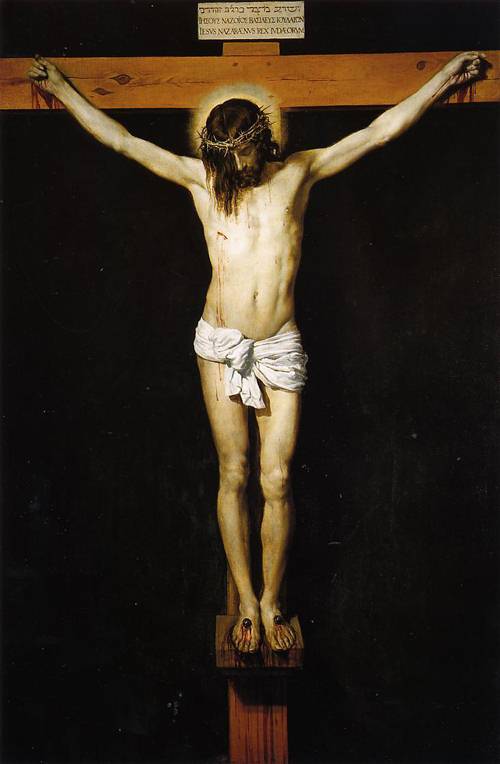
Crucifixion (Diego Velasquez, 1632)
So this all seems more realistic to me, given the realities of a crucifixion. Crucifixion was a death sentence specifically designed to humiliate the victim and draw out death for as long as possible. In fact, it’s where we get the word “excruciating.” Scientists and historians disagree when it comes to the precise way that a crucifixion actually did someone in. Some say victims bled to death or died as a result of infection in the blood. Others say that they died from extreme dehydration. Still others say that they most likely died through asphyxiation, because their permanently outstretched arms made it difficult to expand their lungs properly and breathe. Regardless of how it happened, long and humiliating exposure was the objective, so it is entirely believable—realistic— that, at some point, Jesus, man on the cross, would feel the need to re-hydrate.
As it so happens, for the gospel writer John, Jesus’ desire for something to drink—and the subsequent offer of sour wine—was also a fulfillment of one of the Hebrew Scriptures. John sees an echo of Jesus request in the words of the 69th Psalm, which was a prayer for deliverance from enemies, and we, like John’s initial readers, can use the words to paint the picture Jesus of the cross:
                        “I looked for pity, but there was none;
And for comforters, but I found none.
                        They gave me poison for food,
                        and for my thirst they gave me vinegar to drink.”

Historians tell us that this vinegar or sour wine that the soldiers offered would likely have been on-hand. It was a crude, cheap version of wine that had basically already gone bad, and so it could offer some relief, but not much. They offer it on a sponge extended on a branch perhaps because no soldier wanted him drinking out of one of their cups. For those who’ve paid close attention to Jesus’ life, the irony is overwhelming. Jesus’ first miracle had involved changing water into wine at a wedding at Cana. He had said then that his hour for glory had not yet come, yet the wedding guests then had made special mention of the wine’s high quality. The best wine had been saved for last! Here we find Jesus in his hour of glory, lifted on the cross, and the wine is almost undrinkable. But Jesus drinks it anyway, as I assume any human would.
This is more important than we might initially think. Many of the earliest and thorniest controversies in the Christian faith actually had to do with the relationship between Jesus’ divine and human natures. We think little of this these days, aware of the teaching that Jesus was somehow totally human and totally divine at the same time.  However, some early believers could only make sense of Jesus and his life by saying that he was not truly human at all, that his body was some type of illusion. They looked at the crucifixion and denied that if God was actually hanging there he would be feeling anything at all. People with this viewpoint eventually lost their argument, partly because of Jesus’ human desire and ability to drink while he was dying.
As it turns out, not a single word from Jesus is insignificant. If Jesus says he’s thirsty, it means something huge, even if it just means he’s thirsty. Because if he’s thirsty, he is feeling human pain. He is looking around and feeling the effects of this torment. He is looking for comforters and finding none. And if he is feeling human pain, looking and finding little comfort, then he can be truly with us…not above us or outside of us, but with us, beneath us, in us. That is the miracle of Christ. That is the gift of Son of God: that he is also a son of men.
Early Church theologian, a man named Gregory of Nyssa, put it this way:
“God’s…power is not so much displayed in the vastness of the heavens, or the luster of the stars, or the orderly arrangement of the universe or his perpetual oversight of it, as [it is] in his condescension to our weak nature.  We marvel at the way the sublime entered a state of lowliness and, while actually seen in it, did not leave the heights.”[1]
It’s important that we listen to such words, especially when we’re prone to place our wonder at God in anything other than the cross. It’s important that we listen to Jesus words, even when he’s just telling us he’s thirsty, because when he does, it means God is in human lowliness with us.
And that means, for example, when a cancer patient aches for respite from the chemo and radiation, Jesus aches for that respite, too. Or that when a protester on the street somewhere in the Middle East thirsts for her basic civil rights to be honored, then Jesus is somehow thirsts for human dignity with her, as well. When an abused child craves the love of a parent who will truly care for them, Jesus craves that love alongside of them. When famine strikes an African village, and people hunger for basic necessities, Jesus is present, thirsting and hungering, too.
There was a memorable editorial in The Lutheran magazine a few years ago written by David Miller, then its editor-in-chief . In it he describes a visit to a refugee camp in southern Sudan where people were dying of starvation and disease because the food convoy had not yet showed up. While he was there he crawled into a makeshift hospital, which was little more than a dirt hut with no beds and no medicine—fifteen gaunt people were lying on the floor in some stage of dying.
“I came upon a woman in her twenties,” Miller writes, “sitting by a small lump under a fray, dirty cloth. With one hand she absently fingered a braided string hung around her neck; with the other she held the cloth close around the ‘lump’—a little girl, shrunken by hunger and disease. We sat together helpless, looking at the extinction of her beloved. Then I noticed that she was fingering a cross, crudely fashioned from a piece of twisted wire. Touching her arm, with my other hand I made the sign of the cross full and large across my chest. Her eyes widened, and immediately she pulled at my hands, drawing them to her child. I didn’t know what she was trying to show me. Then I knew: she wanted me to bless her child—as if for dying. I placed my hands on the little girl’s head and commended her to the gentleness of God.
I prayed that in the next life this precious child would find a mercy that had so badly escaped her in this life.” Miller continues, “A power had been released in the bunker’s darkness, and the tears we brushed from our eyes were not only of sorrow, but of joy, hope, and gratitude. We were transported beyond the dismal present to a future where everything was shaped—finally—by the mercy of the One whose pleasure it is to wipe every tear from every eye.”[2]
Miller’s reflection on that experience illuminates perfectly the power of a God who condescends to human weakness. The world needs a savior who forgives from the cross…who offers words of pardon, words of eternal hope and Paradise where, yes, every tear will be wiped away. But, as we know, we thirst for a savior who himself can thirst like us, who can somehow be in that tent with that mother in her pain and sorrow as he can in heaven’s heights. It is a savior who, even as he sips this sour wine—in fact, the worst around—at this final hour is serving up for us what will turn out to be his resurrection finest.

Thanks be to God!


The Reverend Phillip W. Martin, Jr.


[1] St. Gregory of Nyssa, “The Address on Religious Instruction,” Christology of the Later Fathers, ed. by E. Hardy, 300-301 in David Yeago’s typescript, vol. 1, The Faith of the Christian Church.
[2] “Even Here, Even Now,” David Miller in The Lutheran, April 2000


Sunday, March 18, 2012

The Fourth Sunday in Lent, Year B - March 18, 2012 (Numbers 21:4-9 and John 3:14-21)


Anyone who has seen Disney’s The Lion King—either the movie or the musical—is very familiar with that iconic scene that comes right at the beginning. All the animals of the African savannah have assembled around the base of the lion’s home on Pride Rock, an imposing rock formation which juts out over the surrounding Pridelands like the bow of a ship. They’ve come from miles around to witness the birth and anointing of their new lion king, upon whom no animal has yet laid its eyes. At the critical moment, just as the opening music reaches its stirring crescendo, they lower their heads in respect and adoration as the young cub is taken from the lion family by a priest-like ape and thrust into the air, lifted high so that all can see him. Not a word has yet been spoken in the movie. No mention of good or evil—or light or dark—has been made. And yet this gesture of lifting up is so clear in its symbolism, so unmistakable in its message. At that point we know a new king has arrived. It is a judgment upon the state of things: a new day has begun and all may rest peacefully and secure in the great circle of life, as Disney calls it. Of course, this circle of life aspect is driven home once more at the end of the movie as the exact same scene is repeated with a new generation’s lion king.

On a somewhat of a side note, there was a priest in the Roman Catholic parish in the part of Pittsburgh where I served who basically re-enacted this type of pose with every baby at a baptism. It was even colloquially referred to as the “Lion King” pose, and I saw it with my own eyes once as he took one of our friend’s daughters—four months old and very squirmy at the time—and bravely lifted her up seven feet or more over the hard marble floor after he poured the water on her head. He was a sturdy man, but most parents found the symbolism a little too breathtaking at that point.

Lifting up: it’s what we do to things that need attention. It the universal gesture for ‘this is important.’ For ancient Israel, especially in the story to which Jesus refers in this morning’s gospel lesson as he speaks with Nicodemus, it is also the gesture for ‘this is life.’ Moses once lifted up a serpent in the wilderness so that people could look at it and live.

Visit of Nicodemus to Christ (La Farge, 1980)
Nicodemus is a Pharisee who has come under the cover of night to see Jesus and get to the bottom of Jesus’ teachings, if such a thing can be done. We don’t know specifically why Nicodemus is drawn to Jesus. Perhaps Nicodemus is feeling a stirring of new faith because of the signs Jesus has performed. Perhaps Nicodemus wants to nail down the essence of Jesus’ relationship with God and clarify how the Pharisees’ understandings of God differ from Jesus’ so that he can better describe and define the coeternal nature of the second person of the Trinity, whether he is begotten or made…OK, maybe that’s not what Nicodemus is thinking…but whatever Nicodemus’ motivations, the conversation reaches a point where Jesus compares the Son of Man to this otherwise obscure story about the snakes in the wilderness.

In that occurrence, which is recorded in the book of Numbers, the people of Israel had been complaining about what they had to eat in the wilderness. They complained about this several times, in fact, but this time God is provoked to send venomous snakes in their midst. As the snakes bite the Israelites they begin to die. Interestingly, historians have often wondered whether the “fiery serpents” in this account might not have been snakes at all but perhaps an outbreak of guinea worm, a debilitating but preventable parasite that lives in unclean water that still afflicts people in some remote parts of Africa.


Moses and the Brazen Serpent (Bourdon, 1653-54)
Whatever the case, in order to save them God instructs Moses, their leader, to make a serpent out of bronze and hoist it up on pole so that everyone could look at it. And there you have it: lifting up the bronze serpent means life. All the Israelites who are gathered out on the plain of the savannah can look at it and be saved. Life can go on.

As a Pharisee, someone familiar with the Law and the history of his people, Nicodemus would have known that story well. What would have seemed strange was to hear Jesus, this new and confusing rabbi, compare himself to that story. Jesus, you see, would not just come to teach something new about life in God, or to impart some novel understanding through signs and wonders, like changing water into wine (Pharisees lap up that kind of stuff, you know). Rather, Jesus would come as the Son of Man to be lifted up. Jesus would come to be lifted up as important, to be lifted up as life. Furthermore, what Nicodemus could never predict is that here Jesus really means “lifted up”…that he, too, would be attached to a crude pole and lifted high for all to see.

The act of lifting Jesus up, as it turns out, is one of the chief themes in the gospel of John. Like the recurring imagery that serves to anchor the story in The Lion King, this action is referred to and repeated at various key times in the gospel story. This conversation with Nicodemus is one of those occasions, and as we read on, we learn that “lifting up” is the word that Jesus uses for his death on the cross. Where in the other gospels, Jesus speaks about his death in terms of humiliation and suffering, here Jesus repeatedly mentions it in positive terms. When Jesus is lifted on the cross, God is saying “This man is important, this event is significant.” And more than that: God is saying, “This man is life. Look at him and live.” By being lifted up on the cross to die, Jesus is later able to be lifted up in the resurrection in victory over death and then, again, lifted up in his ascension to the Father. Being lifted up: for Jesus, it’s all one continuous motion that is directed at you and me, and we may live as a result of it.

It all seems a little intellectual and heady, doesn’t it? Much of John’s gospel comes across that way—at least, it does to me. What it all comes down to is this: when Jesus is lifted on the cross, we see the effect of what is truly killing us. We see in Jesus’ crucified body the result of our sin, that fiery serpent that will not leave us alone. We see in Jesus’ crucified body the incredible pain our brokenness causes, both to ourselves and to God. In this sense, the cross is also God’s judgment. We see and understand that, left to ourselves, we are doomed people, wandering aimlessly towards certain death. An essential part of Christian faith is a realization of how much help we need, how dead we really are, how hopeless our situation is until God does something to save us. I dare say that is not a popular point of view these days—that is, the admission of the failures and utter helplessness of humanity and of the fact we can’t save ourselves. Yet this is what we see when Jesus is lifted up.

Crucifix (Michelangelo, 1492)
However, we also see in Jesus’ cross that which brings us life. And what brings us life, true life? The love of God brings us life—a love so great that we see God will give his only Son to have us back on the journey toward home, and that everyone gathered on the savannah of this planet may see him lifted up and, believing in him, have eternal life. Indeed, a new day has arrived. Life may continue in the presence of God, now and forevermore.

At the center of Lutheridge, a Lutheran camp and conference center just south of Asheville, North Carolina, there is a small lake (or large pond, depending on your frame of reference). At one end of the lake a large, white cross has been lifted up and placed at the point where shorelines come together by the feeder creek. Even if you’ve never been there before, you can imagine what it looks like: I suppose it looks similar to any other cross that’s been placed at any other water’s edge. At night it’s particularly beautiful because a bright floodlight placed in front of it helps the cross form a reflection on the water below.

One summer as I was working as a counselor there, a pastor who had brought his confirmation students for a week at camp led some staff devotions before we all turned in for the evening. Normally these devotions would take place in a room or on the balcony of some lodge or cabin, but that night this pastor decided to take us all down to the lake to look at the cross.  And rather than lead us to a nice spot across the lake, this pastor traipsed us through the woods to the back of that cross. Standing there in the stark shadow that was formed by the floodlight hitting the cross at such close range, he asked us to look up at the cross and tell us what we saw. In the presence of a pastor, we all spouted out our best theological answers: “Forgiveness.”  “Love.” Someone I’m sure mentioned that old Lutheran standby answer, “Grace.” None seemed to be the exact answer he was looking for. He let us go on for a few seconds before he said, “Sure.  That all sounds good. What I see is simply God, on the other side, looking back at us. Remember this: whenever God looks at us, he is viewing us through the cross of his own Son, Jesus.”

What that pastor was saying is that, in Jesus, God judges us dead in sin and, at the same time, loves us…loves us for all time, even through death. Like much of John’s gospel, the meaning of the cross can difficult to summarize, difficult to grasp, and like Nicodemus, we may be totally puzzled by the ways of a God who would lift up his Son in this humiliating way. We, too, may ponder it more often than we understand it, and fade away from his conversation in the same way Nicodemus does, only to arrive at a deeper faith later in our story.

No matter what—whether we’re by a lake at a church camp or maybe here, on Sunday, receiving his body and blood in the shadow of this wooden replica—my prayer for each of us is that on the journey through this wilderness we may eventually find our place not, as Disney hopes, in the circle of life, but rather at the foot of the One who has been lifted up for us, in the graciously bright light at the cross of life.


Thanks be to God!


The Reverend Phillip W. Martin, Jr.


Sunday, February 26, 2012

The First Sunday in Lent, Year B - February 26, 2012 (Genesis 9:8-17, Mark 1:9-15)


I realize she may not technically be classified as a “wild beast,” but our cat, Luna, does have a tendency to go wild on us most mornings at about…oh, 5:00am. She usually starts by purring in my face. Soon she is standing on my chest, head-butting my chin. If I don’t wake up, she begins walking around on my stomach to make the point. I can shove her off, but then she’ll just repeat her tactics with Melinda, who is usually much more patient with her. If we shut Luna out of the bedroom, then she impatiently and noisily scratches at the door until we let her back in. It’s enough to confirm my sensibilities as a dog person, although I hear they’re not much better about this.

beastly Luna on the prowl
It wasn’t until a few days ago, however, that we started connecting the dots of this animal behavior to realize that Luna’s morning antics correspond to our children’s restlessness. Sure enough, if Luna wakes us up, it is because she has sensed some stirrings in the kids’ bedroom…perhaps a wet bed or a nightmare or playing with toys before they’re supposed to. It’s all like a miniature version of the well-documented phenomenon that animals can sense something is up in the hours and minutes before the strike of a natural disaster. We’ve all heard the stories. No one really knows why or how this happens. Perhaps it’s their superhuman sense of hearing or ability to sense changes in the atmosphere. Call it raw instinct, call it some special inner sense, but animals seem to know, in many cases, when something is up. They respond to certain critical situations often before humans do.

In fact, I wonder if something along these lines might be happening in this account of Jesus’ temptation. After he is baptized, Jesus is driven into the wilderness where he is with, of all things, the wild beasts. It is the only place in all of Scripture, in fact, where Jesus is with animals,  with the sole exception of the donkey he rides on Palm Sunday. I would guess most of assume there were animals and beasts at Jesus’ birth:


“I,” said the donkey, shaggy and brown,
"I carried his mother uphill and down,

I carried his mother to Bethlehem town."

"I," said the donkey, shaggy and brown.


But, truth be told, neither Matthew nor Luke, the two gospel writers who record Jesus’ nativity, say anything about animals in the stable, even a donkey, shaggy and brown. In the way that Mark tells the gospel of Jesus, the friendly beasts show up just following Jesus’ baptism when he is in the wilderness being tempted by Satan.

And, yes, it is a critical situation. Something, you might say, is up.  This, my friends, is a turning point, not just in the life of Jesus as he heads out to an intense time of trial, but in the life of the entire world. This is a new beginning. God had once before cleansed the world with water. God had made a covenant with Noah and all the animals of the ark after forty long days of rain that a fresh new day of promise had dawned. The heavens had opened and hope had shone through in the form of a rainbow. God would never again destroy the earth in order to restore it. Now, once again, after forty long days in the wilderness, after the heavens had torn open and hope had shown through in the form of a dove, God is restoring creation through the life of his Son.

Edward Hicks, The Peaceable Kingdom (1826)
This, Mark means to tell us, is moment all of creation has been waiting for, even, it seems, the wild beasts. In the baptism of Jesus and his subsequent temptation in the wilderness, a brand new day has begun. God has announced a new chapter—the final chapter, in fact—in his plan to reconcile the entire cosmos to himself, and strangely, even before Jesus has called his first disciple, the wild beasts are gathering around him as a sign of the peacefulness and promise to come, a vision of Paradise regained. It’s fun to imagine that some of them may even be purring and head-butting his chin in playful expectation that something important is about to happen.

How about you? Do you feel the draw to gather around Jesus, to respond to his announcement that the kingdom of God has come near? Do you long, too, for a fresh beginning, a total do-over of your life, another start? Are you, worn down by years in the wilderness, searching the skies for a sign of hope? The good news from the gospels is that in Jesus this fresh start, this new beginning, is always possible, for each and every one of us. Your age does not matter. Your personal background does not matter. In Jesus, God has come to contend with the fears, the temptations, the dark forces that estrange all people from God and the good that God desires for us. This new day begins that day by the Jordan River and reaches its conclusion at the cross in a new flood of grace where God own Son takes all the all the sin the world and drowns it in love.

river baptism
For the sinner, this is made real in the waters of baptism, regardless of our age when that occurred. Whether we were a tiny infant or a college student or an older adult, our baptism is a sign that we’ve been forever included in this new covenant established by Jesus’ life and death. God has claimed us as a member of his new creation and we are united to Jesus’ life eternally. Even if we forget it or were too young to remember it. Even if we, at times, act like it never happened. Out of God’s amazing grace we are chosen and gathered as his children. And each time we reflect on our own baptisms we are provided the opportunity to reflect on just how powerful and permanent God’s love for creation is: that Jesus will be driven into the wilderness to save it. That Jesus will die on the cross to claim it. That he will rise again to show his power for it. And so,baptism is a chance to begin again. Even remembering it, as Martin Luther says, is a chance to start our lives anew and, once again, take part in the kingdom of peace and righteousness that Jesus has begun.

One Easter in the first congregation I served we baptized a man who was in his fifties. He had first ventured into our congregation with his wife earlier that year in January after having driven by the front door regularly for about six months. It took him that long, he said, before he finally got up the nerve to come inside. We used that Lent as a time to have some intentional conversations about his life and his faith and where he had perceived God’s activity in his life. We came to the conclusion that it was time for him to be baptized. For reasons unknown to him, his parents had never taken that step with him when he was young.

That Sunday, as the water was poured over his head, a new thing for that congregation occurred. He began to weep.   It caught everyone by surprise, although perhaps it shouldn’t have. The people in the choir, who were standing nearest to him, were affected by his visible show of emotion. Some of them began to cry too, confronted with the seemingly un-Lutheran reality of a grown man moved to tears in worship. I’ll never forget a comment one of them made after worship was over as she reflected on the event:  “It was like it meant something to him,” she said.

Indeed, something had happened. Something was up, and we watched as over the next months and years the splash created by his baptism rippled throughout the entire congregation, just as the same grace ripples throughout this congregation when Pastor Chris or I walk a new child of God up and down the aisle after a baptism. Something is up in the life of Jesus Christ, the likes of which this whole world has never experienced or seen before. Whether our baptism occurs as an infant, as a child, as an adult God’s purposes are made clear: Jesus is on the scene.  He has come for us.

And even when powerful emotion is not there in our faith, it is still true that the days where sin has complete power are now behind us. The days of hope and promise have arrived. God has claimed us for his grand new restoration project on earth, and each person—be they young or old, be they intimidated by the front doors of the church or as comfortable in a pew as in their family room sofa—has the Spirit-given gifts to join in on the effort.

This does not mean, it should be noted, that the Christian life will be easy, that taking part in this restoration flood will involve no tests and trials. After all, once his own baptism is over, Jesus is driven by the Spirit not into a field of daisies, but into the wilderness for a time of testing. As members of his body, we should expect the same type of experience, subjects of a kingdom whose existence and goodness is not yet completely recognized by the rest of the world.

In one of his books, former Divinity School professor and United Methodist bishop Will Willmon tells the story of a newspaper clipping he once read about a woman somewhere in Louisiana who had raised somewhere around a dozen foster children despite her low, meager income as a domestic worker. Why did she do it?  Why did she suffer so? She responded, “I saw a new world a comin’.”[1]

A new world is a comin’. Something, brothers and sisters, is up. And as far as Mark is concerned, the animals might already sense it. You can see it in the ministry and in the lives of people in this very congregation. By the grace of God, we have a new beginning in Jesus Christ. It starts with a splash, then forms a ripple, until all of creation is caught up in the flood.

Wake up!  Turn around!  And believe in the good news.”                


Amen!


The Reverend Phillip W. Martin, Jr.


[1] Will Willimon, Pastor: the Theology and Practice of Ordained Ministry.  Nashville: Abingdon Press, 2002. Pg 127